
- Consistency between environments
- Single point of failure services
- Differing environment requirements (Not all environments are created equal)
- Managing multiple environments across multiple clouds
All
of these factors and many more can lead to time wasted, applications
being released into production before their time, or worst of all
unhappy software engineers.
DevOps to the rescue?
Wouldn't
it be nice if the software engineer just worried about their
application and its code, instead of all of the environments that it has
to run on? In some places that is exactly what happens. Developers
develop on their local laptops or in a development cloud and then check
in their code and it moves to production. DevOps cleans up any problems
with applications using single instance bottle-necked services, out of
sync versions of centralized services, or adding load balancing services
to the front end or back end of the application. The App developers
have no clue what mess they have caused with their code changes, or a
new version of service that they are using. Somehow we need to make sure
that the application developer is still connected to the application
architecture but disconnected from the complexity of managing multiple
environments.
Single Definition Multiple Environments
Working on my Local machine
One
approach that I have been looking at is having the ability to define my
application as a set of service templates. In this simple example I
have a simple Node JS application that uses Redis and MongoDB. If I use a
yaml format. It might look something like this.

- MyApp:
- Services:
- web: NodeJS
- ports: 80
- links: mqueue, database
- mqueue: Redis
- ports: 6789
- database: MongoDB
- ports: 25678, 31502
So
with this definition I would like to deploy my application on my local
box, using Virtual Box. I put this yaml file in my home directory of the
application. This should be very familiar to those of you that have
used docker-compose. Now I should be able to launch my application on my
local machine using a command similar to docker-compose.
$ c3 up
After a couple of minutes my multi-service application is running on my local laptop.
I can change the application code and even make changes to the services that I need to work with.
Working in a Development Cloud


Now
that I have it running on my laptop I want to make sure that I can run
it in a cloud. Most organizations work with development clouds.
Typically development clouds are not as big as production and test
clouds but give the developer a good place to try out new code and debug
problems found in production and test environments. Ideally the
developer should use the same application definition and just point to
another environment to launch the application.
$ c3 up --env=Dev
This
launches the same application in the development environment. Which
could be a OpenStack, VMWare or Kubernetes based SDI solution. The
developer really does not care about how the infrastructure gets
provisioned, just that it is done quickly and reliably. On quick
inspection we see a slight difference in the services that are running
in the development cloud. There is another instance of the NodeJS
service running. This comes from the service definition of the NodeJS
service. The NodeJS service is defined to have multiple instance in the
development cloud and only one instance in the local environment.
NodeJS.yml - Service Definition
- NodeJS:
- Local:
- web:
- image: node-3.0.2
- port: 1337
- Dev:
- web:
- image: node-3.0.2
- port: 1337
- worker:
- image: node-3.0.2
- port:1338
- cardinality: 3
- Test: …
- Prod: …
This
definition is produced by the service and stack developer not the
application developer. So the service can be reused by several
developers and can be defined for different environments (Local, Dev,
Test, & Production). This ensures that services are defined for the
different requirements of the environments. For example Production
NodeJS might have a NGNX load balancer on the front end of it for
serving up NodeJS web services for each user logged in. The key is that
this is defined for the Service
that is reused. This increases re-usability and quality at the same time.
Working in the Test Cloud
Now
that I have tried my application in the development cloud. It is time
to run it through a series of tests before it gets pushed to production.
This is just as easy for the developer as working in the development
cloud.
$ c3 up --env=Test$ c3 run --env=Test --exec runTestSuites
We
launched the environment and then run the test suites in that
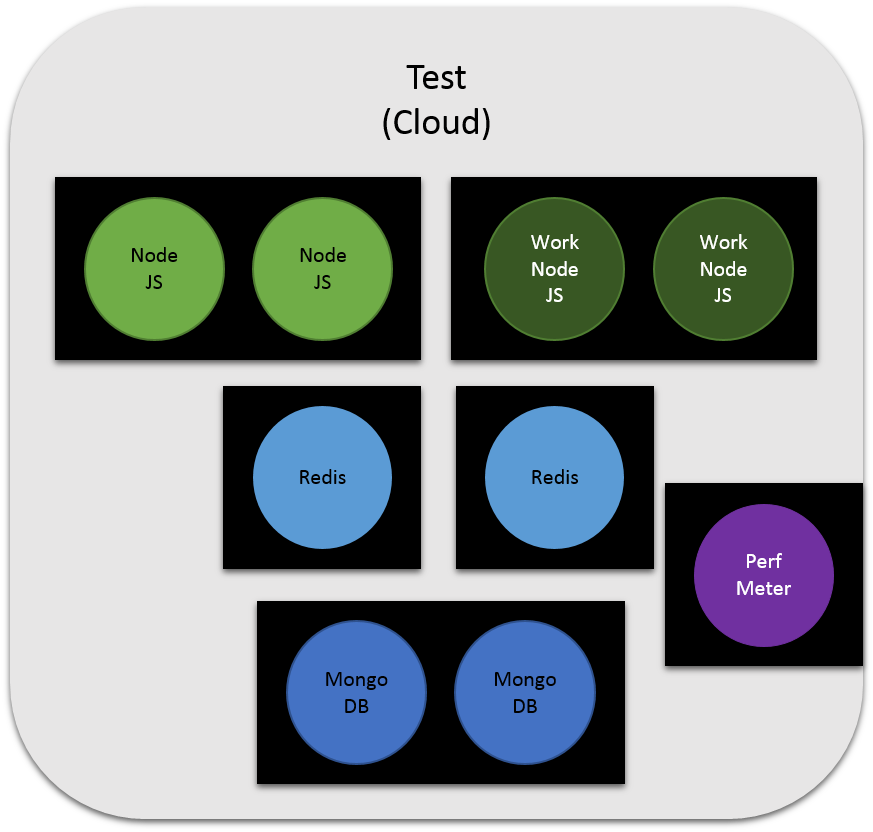
environment. When the environment launches you can see additional
instances of the same services we have seen before in the development
cloud. Additionally, there is a new service running in the environment.
The Perf Monitor Service is also running. It is monitoring the
performance of the services while the tests are running. Where did the
definition of this service come from? It came from the application stack
definition. This definition just like the service definition can show
that the application can have a different service landscape for each
environment. But the software developer still sees them as the same.
That is to say, code should not change based on the environment that is
running the application. This decouples the application from the
environment and frees up the software developer to focus on code and not
environments.
What about Production


The
ultimate goal of course is to get the application into production. Some
organizations, the smart ones, don't let developers publish directly
into production without some gates to pass thru. So instead of just
calling "c3 up --env=Prod" we have a publish mechanism that versions
the application, its configurations and supporting services.
$ c3 publish --version=1.0.2
In
this case the application is published and tagged with version 1.0.2.
Once the application is published, it will then launch the environment
if it is not currently running. If it is running then it will "upgrade
the service" to the new version. The upgrade process will be covered in
another blog. Needless to say it allows for rolling updates with minimum
or no downtime. As you can see additional services have been added and
some taken away from the test environment.

Happy "Coder" Happy Company
The
software engineer in this story focuses on writing software not on the
environment. Services are being reused from application to application.
Environment requirements are being met with service and application
definitions. Stack and service developers are focusing on writing
services for reuse instead of fixing application developers code. Now
your company can run fast and deploy quality products into production,
Check out more detailed architecture and use cases on github at https://github.com/CAADE/C3/wiki.
You can see the video of this blog here
DWP
Check out more detailed architecture and use cases on github at https://github.com/CAADE/C3/wiki.
You can see the video of this blog here
DWP


